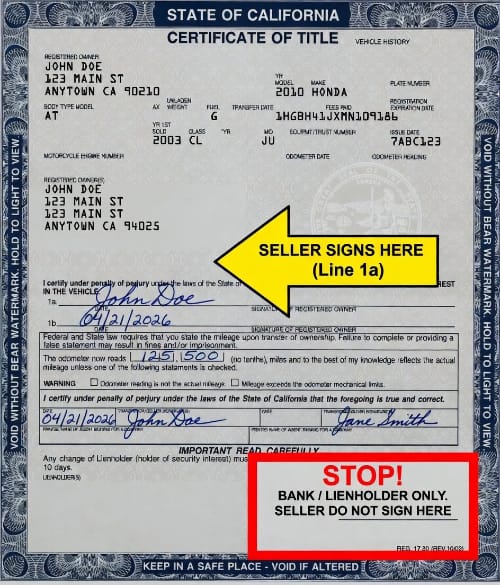


Hey, it’s Sonny. The call usually goes the same way: somebody’s selling a car in Anaheim or Reseda, the buyer signs the title, and a second later everyone realizes the name landed on the wrong line. Now there’s a signature sitting where it shouldn’t be on an official ownership document, and the seller is sure the title is ruined. It’s not.
The DMV built a form for exactly this mess, the REG 101, and it does one of two completely different jobs depending on which half of the page you fill out. I buy cars all over SoCal, and I’ve talked plenty of sellers off the ledge over this one. Call me at (714) 900-3723 if you want to talk through what’s on yours, I answer personally. Otherwise, keep reading and I’ll show you which half you actually need.
The 30 Second Answer
Jump to: the top half · the bottom half · what to write · is this even the right form · quick answers
One form, two completely different jobs
The REG 101 is a dual purpose form, and mixing up the two purposes is the most common mistake I see. Even the official name says it: Statement to Record Ownership, Statement of Error or Erasure. Two statements, one sheet of paper. So download the REG 101 free from the DMV, print it at home, and only fill out the half that matches your problem.
Here’s the split. The top half records or clarifies who owns the vehicle. The bottom half explains a mistake somebody physically wrote on the title. If nothing is written wrong on your title, stay off the bottom half. And if your ownership info is clean and complete, then the top half has nothing for you either.

One warning before we go through it, because the DMV says this plainly in their own manual: they use the REG 101 to prepare your new certificates. So a typo on this form becomes a typo on your next title, which means voided certificates and another round of corrections. Slow down and get every name exact.

click here for the example pack
The top half: Statement to Record Ownership
This half exists to clarify the registered owner or legal owner names and addresses when the main application can’t hold them cleanly. Then the DMV types your new title straight from what you write here, word for word.
A few real situations trigger it. Multiple owners whose full legal names won’t fit clearly in an application’s boxes. A leased vehicle where the application has no separate spaces for the lessee’s and the lessor’s addresses. Or a title that passed through a chain of buyers who never registered it, so the DMV needs one clean statement of who the true owners are now.
Filling it out is mostly what you’d expect. Vehicle info goes up top: the plate or CF number, the VIN, and the make. Then each owner’s true full name, last, first, middle, exactly as it reads on their California driver license or ID card, with the license number beside it. Nicknames defeat the whole point of the form. There’s also a spot for the purchase date and price, plus the lien holder’s name and address, and you write NONE there if you don’t have one.
AND or OR: two little words with long consequences
Between the owner name lines you’ll find checkboxes for AND or OR, and this choice matters more than anything else on the page. Names joined by AND mean every owner must sign to transfer the vehicle later. Names joined by OR mean any one owner can sign alone. So a couple who wants either person able to handle a sale usually wants OR, while co-owners who want a mutual veto want AND. Think about the day you sell before you check a box.
Now the trap. If you skip the checkboxes entirely, the DMV doesn’t call to ask. Instead, they issue the new certificates with a slash between the names, and a slash gets treated as AND. So both signatures, every transaction, from then on, because nobody checked a box. That slash stalls more sales than people expect, especially years later when an ex or an old business partner has to be tracked down for one line of ink.
The bottom half: Statement of Error or Erasure
The bottom half handles a different problem: something written on the California title in error, or erased from it. A buyer’s signature on the wrong line. A name entered where it doesn’t belong. An entry that got lined out. Before processing the title, the DMV wants a REG 101 explaining any erasure or lined out information on it.
Here’s the part that surprises people, though: you don’t have to compose some perfect legal statement. The declaration is already printed on the form. It states that the name appearing on or erased from a specific line of the title was in error and has no bearing on ownership. So your job is just to fill in that line number, the vehicle info, and a short explanation in the reasons box.
And the signature rule is strict. The person who made the error signs the statement, not the vehicle owner. If a buyer signed your title on the wrong line, that buyer completes and signs the bottom half. There’s one exception: when a printed name or address gets lined out, the person who made the entry in error can complete it. Either way, the signature goes under penalty of perjury, though there’s no notary block anywhere on this form.
What to write in the reasons box
Keep it plain, factual, and first person. Something like: “I signed line 1 during a sale that was not completed. I never took ownership of this vehicle.” That’s the whole job. No legal language, no drama, just an honest explanation from the right person. Short and true beats long and fancy at the DMV counter every single time.
Steal these. Word for word.
Buyer signed the wrong line:
“I signed line 1 in error while completing a purchase. The signature was intended for the buyer section. I have no ownership interest in this vehicle.”
Sale that fell through:
“I signed line 1 during a sale that was not completed. I never took ownership of this vehicle.”
Name lined out:
“The name on line 2 was entered in error and lined out. That person has no ownership interest in this vehicle.”
Swap in your line number, sign it, date it, and add a daytime phone number at the bottom. The DMV wants to be able to call the person who made the error, not the owner.
Mistakes that turn a small fix into a big one
First, correction fluid. If a wrong entry needs fixing, a single line through it plus a REG 101 is the path the DMV recognizes. But globbing white out over an entry, or scribbling until nothing underneath is readable, risks turning a fixable error into an illegible title. And an illegible title means a duplicate title application instead, so my REG 227 guide covers that road if you’re already on it.
Second, the odometer section. An error in the odometer disclosure is the one mistake the REG 101 cannot fix. Odometer corrections run through the REG 262, and a REG 262 can’t be altered or erased at all once it’s filled out. So the 101 fixes title errors, and it never touches mileage entries.
Third, mailing it alone. The DMV’s manual says the REG 101 must accompany the completed application it supports. It’s a rider, not a solo document. Send it attached to your transfer or registration paperwork, never by itself.

The forms people mix up with the 101
Lost the title completely? Then there’s nothing to correct because there’s nothing to look at, and that’s a duplicate title job through the REG 227 instead. Need to explain circumstances rather than ink, like a gift, a family transfer, or a tax exemption? That’s the REG 256 Statement of Facts. And if you’re staring at the pink slip trying to work out what goes where before anything has gone wrong, start with my guide to filling out a California title.
The DMV’s own transfer page sorts it the same way. Title changes route through a handful of forms, and the 101’s lane is narrow: ownership clarity and written errors, nothing else.
| Your situation | The form you need |
|---|---|
| A name or signature landed on the wrong line of the title | REG 101, bottom half |
| Owner names or addresses need to be recorded or clarified | REG 101, top half |
| The title is lost, stolen, or too damaged to read | REG 227 duplicate title |
| You need to explain circumstances, a gift, a family transfer, a tax exemption | REG 256 Statement of Facts |
| The odometer disclosure has a mistake in it | REG 262, and only a fresh one |
| You sold the car and want your name off the liability | REG 138 release of liability |
Quick answers on the REG 101
The sixty second recap
The REG 101 is two forms sharing one page. Up top, it records or clarifies who owns the vehicle, and the AND or OR choice decides whose signatures the car needs for the rest of its life. Down below, it explains a name written or erased in error, signed by the person who made the mistake. Skip the checkboxes and you get AND by default. Use a single line, never white out. And keep it far away from odometer entries.
Or skip the whole thing. When I buy a car anywhere from Long Beach to the San Fernando Valley, the paperwork becomes my problem, the 101 included. I’m a SoCal resident just like you, I answer personally, and I’m not a corporate robot.
Got a wrong signature on your title and a car you’d rather turn into a fair offer? Selling without a clean title is something I handle every week. Cypress office: (714) 900-3723. Van Nuys office: (818) 405-8808. Open 8 AM to 8 PM, seven days a week. And if it’s not the right fit, I’ll lead you in the right direction.