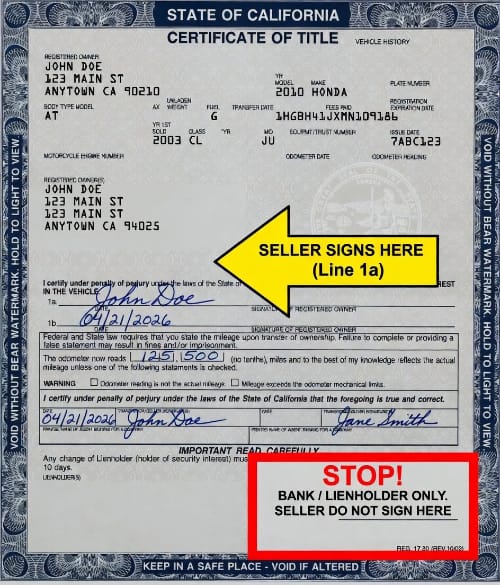


The loan got paid off in 2019 and the bank is still printed on the title. Now somebody wants to buy the car and you cannot sell it, because a buyer cannot register a vehicle that still has a legal owner listed. My name is Sonny Miller and I have been buying cars across Southern California for over 20 years. I run into this one constantly.
The fix is a one page form called the REG 166, and there are exactly three things that stop people. Call me at (714) 900-3723 if the title is the only reason the car is still sitting, I answer personally. Otherwise, here is the whole thing.
Six Things Before You Print It
Download the free REG 166 cheat sheet (PDF), including the step by step path when the bank is gone.
What the REG 166 Actually Does
The full name is the Lien Satisfied, Legal Owner, Title Holder Release. It is the bank saying, in writing and in front of a notary, that the loan is paid and they are done with this vehicle. It stands in place of the lender signing your title.
One form, one purpose. The lender fills in section 3, an authorized agent signs, a notary stamps it, and the legal owner comes off. That is the entire job.
The Three Walls People Hit
Wall one, the notary. The form must be notarized, and the only exception is an insurance company pulling a salvage certificate. People print it, get a signature from a branch manager, mail it in, and it comes right back.

Wall two, the model year. This form cannot release the lien on a vehicle that is two model years old or newer. On a newer car, only the Certificate of Title can do that. Wall three, the paperless title. If your lender is on the Electronic Lien and Title program, the DMV holds your title electronically. There is no paper, so there is nothing to release with this form. Pay the loan, the lender clears it electronically, and a paper title shows up in your mailbox.
Older car, paper title, bank still listed
REG 166, notarized.
Car is two model years old or newer
Only the Certificate of Title releases it.
Never received a paper title
ELT. The lender releases it electronically.
Bank merged or was acquired
Find the successor, they sign the REG 166.
Lender is gone and will not respond
Certified letter, 30 days, REG 256 and a bond.
Bank has no record of the loan
Notarized no-interest letter on letterhead, plus a bond.
When the Bank Does Not Exist Anymore
This is the version I see most, because a car sitting fifteen years outlives a lot of credit unions. The DMV knows it too, and they keep an alphabetical list of financial institutions that merged, closed, changed names, or got acquired, with the likely successor next to each one.
Look up the name printed on your title. More often than not there is a successor bank, and that successor can sign your release. If the list comes up empty, the FDIC failed bank list and your original loan paperwork are the next stops.
- Certified letter to the lienholder address on your registration.
- Wait 30 days.
- Send the DMV the returned letter or receipt, a REG 256 with section G, and a motor vehicle bond.
- The DMV responds in about four to six weeks.
Print the one-page cheat sheet.
The Last Resort Path, Step by Step
Say the lender is truly unreachable. There is a documented route, and it works, it just takes patience. Send a certified letter to the lienholder address on your registration asking for the release. Wait thirty days.
If nothing comes back, mail the DMV the unopened returned letter or the postal receipt, a REG 256 Statement of Facts with section G filled out explaining how you got the car and how you valued it, and a motor vehicle bond purchased for the car’s current retail value from a business licensed in California. The DMV gets back to you in about four to six weeks.
That is real work, and it is the reason a lot of these cars just sit. If that sounds like more than you want to take on, keep reading.
Who Signs It and How
Not you. The lienholder signs, through an authorized agent of the company. The form wants the company name, the agent’s signature, their printed name, and their title with the company, plus a daytime phone number. Then the notary completes section 4 and applies the seal.
Your part is sections 1 and 2: the vehicle information and the registered owner name exactly as it appears on the title or the contract. Get the name right. A nickname on this form starts the whole loop over.
If the Title Is the Reason the Car Is Sitting
Here is my honest place in all this. A private party buyer cannot register your car with a bank on the title, so you have to clear it before you sell. Unless you sell to somebody who handles title problems every week.
I have bought cars with dead lienholders, missing releases, no title at all, and years of back registration. The paperwork becomes my problem once we shake hands, and I do it at your curb. If your situation is one where you should chase the bank yourself instead, I will tell you that too.
The REG 166, Asked and Answered
Paid Off Years Ago, Still Stuck?
Call me and tell me whose name is on the title. If the fix is a phone call to a successor bank, I will point you at it and you keep the car. If the fix is a bond and a six week wait, and you would rather just be done, I buy it as it sits. I am a Southern California resident, not a corporate robot.
Sell a Car With a Lien Problem
One call. A real number. The title mess becomes my problem.
Sonny Miller
GoCarBuyer.com
Cypress Office: 10601 Walker St Suite 102, Cypress, CA 90630
Van Nuys Office: 6360 Van Nuys Blvd #16, Van Nuys, CA 91401
Open 8 AM to 8 PM, 7 Days a Week. Find Us on Google Maps