

Hey, it’s Sonny. I get calls from Ventura, Oxnard, Thousand Oaks, Simi Valley, all the way down to San Diego, asking the same question: how do I actually fill out my California title? People overthink it, and then they under-think the two spots that actually bite, the signature lines and the odometer boxes. I’ve been buying cars across Southern California for over 20 years, and I’ve watched one stray pen stroke turn a five-minute sale into a DMV project. So here’s the whole thing as a follow-along, step by step, in the exact order you’d do it with the title in front of you. And if you’d rather skip all of it, call me at (714) 900-3723, I bring the paperwork and fill it out on the spot.
Before you touch the pen
Get three things ready, because the title is secure paper and there are no do-overs with white-out:
- The title itself, plus your registration card to check names against
- One pen, blue or black ink
- The other person, because both sides sign, and the smart move is doing it together
Quick check while you’re at it: if the brand box near the top says SALVAGE or REBUILT, the signing below works the same, but the sale itself runs a different road. My salvage title guide covers that one.

Selling the car? Follow these steps in order
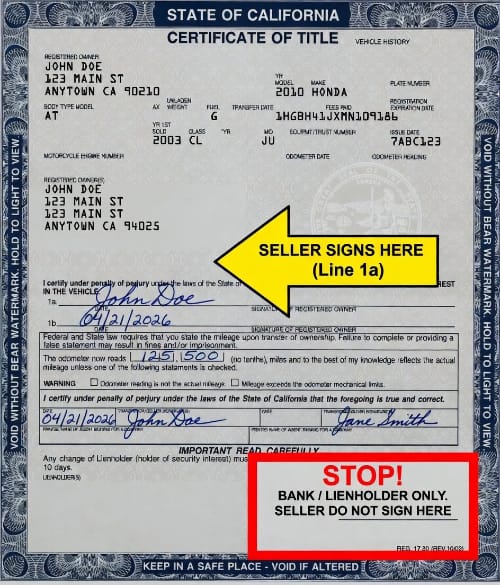
Step 1: Read the names at the top before anyone signs. Look at how the owners are joined. Names joined by AND, which shows as a slash on DMV records, mean every owner has to sign. Joined by OR, one signature does it. Decide who’s signing before any ink hits the paper, because couples get burned on this constantly.
Step 2: Sign line 1a. This is the signature that releases the car. Sign the name exactly as the title shows it. If the registration says Michael, Mike doesn’t cut it.
Step 3: Date it. The date cell sits right there on line 1a. Use the actual sale date, the same one going on your release of liability later.
Step 4: Co-owner signs line 1b. Only if the names are joined by AND. Same rule: exact name, real date.
Step 5: Write the mileage in the odometer boxes. The reading as of the sale, straight off the dash.
Step 6: Leave the two warning boxes EMPTY. Here’s the part people get backwards: if your reading is true, you check nothing. Check a box only when something’s wrong, one means the odometer rolled over past its limit, the other means the reading isn’t real, broken or unknown. This section is signed under penalty, so mark only what’s true. And if your title’s mileage area already says exempt, the car has aged out of the disclosure, leave it be.
Step 7: Sign the odometer line too, then date it and print your name. This is the second signature, on the transferor/seller line inside the odometer section, and it’s the one sellers miss. On 2011-and-newer vehicles, skipping it gets your buyer turned away at the DMV window. Two signatures on the front, not one.
Step 8: Hand the pen to your buyer for one box. Right next to your signature sits the transferee/buyer box. Your buyer countersigns the mileage there and prints their name. Don’t let them skip it.
Step 9: Leave line 2 alone. That line belongs to the bank, not you. Paid off with nothing on the DMV record? It stays empty. A lienholder still printed there? They sign line 2 or hand over a lien release letter before any money moves, and if that bank merged or vanished years ago, the DMV keeps a listing that traces lenders through every change.
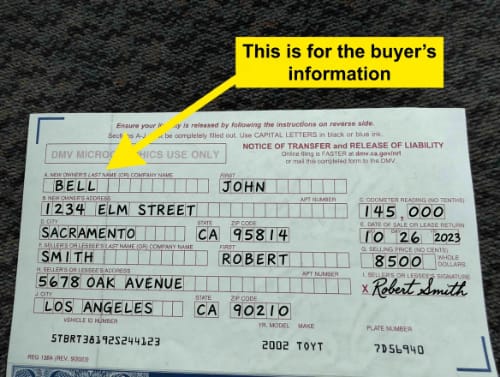
Step 10: Collect the buyer’s full name and address. Not for the title, for your release of liability. Without it, the DMV can’t process your notice.
Step 11: File your release of liability within 5 days. That’s the real legal deadline, California Vehicle Code section 5900, five calendar days, not ten. The online NRL updates the record within one business day, and it needs the buyer’s name and address, the plate and last five of the VIN, the odometer at sale, and the date. Save the confirmation page. My REG 138 guide covers the paper version field by field.
Step 12: Better yet, go finish it together. Because the NRL is not a transfer, the DMV says so in bold. The title stays in your name until the buyer completes their side, and private buyers drag their feet for weeks. So go WITH them, to AAA if you’re a member, a registration service, or the DMV, and walk out holding a printout of the new registration in their name. That printout is the only instant proof the car is out of your life. Until then, their red lights and tolls trace back to you.
The three don’ts that void titles
- Don’t sign before the money’s in your hand. A signed title is a bearer document, whoever holds it can claim the car.
- Don’t touch white-out, ever. A wrong entry gets one clean line through it plus a Statement to Record Ownership, the REG 101, filed by whoever made the error. Correction fluid or heavy scratch-outs make a mutilated title, and that means a REG 227 replacement application and a 15 to 30 day wait.
- Don’t write the price on the front or fill the buyer’s side. Price and buyer details live on the back and on the bill of sale, the REG 135, which is free and covers you both.
Buying the car? Follow these steps in order
Step 1: Sign the front first. Before you flip anything over, your first signature lands in the odometer section’s transferee/buyer box, right next to the seller’s. That’s you acknowledging the mileage. Print your name under it.
Step 2: Flip it over and print your name. The back is the Application for Transfer by New Owner. Line 3a wants your full legal name exactly as your driver’s license shows it, last, first, middle, one letter per box.
Step 3: Adding a co-owner? Choose AND or OR on purpose. The little boxes at 3b decide the car’s future: AND means every future sale needs both signatures forever, OR means either owner can act alone.
Step 4: Fill in where the car will live. Street address, city, state, ZIP, and the county where it’s garaged.
Step 5: Sign and date line 9a, and add your driver’s license number. Every new owner signs their own line.
Step 6: Enter the purchase date and price. Matching the bill of sale, because California calculates your use tax from that number. Buying as a gift or from family? The tax section below tells you exactly what to write instead.
Step 7: Handle line 11, the new lienholder. Financing the car? The lender’s info goes here. Paying cash with no loan? Write NONE. A blank line and NONE are not the same thing to the DMV, and blank is a rejection.
Step 8: Gather the two things the DMV wants with the title. The seller’s smog certification, valid 90 days, required for most transfers, so confirm it’s current before money moves. And your fees, which vary by vehicle and county, so run the DMV’s fee calculator instead of guessing. If the car failed smog or the check engine light is glowing, a private sale gets complicated, and that’s a situation I buy through every week.
Step 9: Submit within 10 days. That’s the DMV’s clock, and late transfers stack penalty fees that only grow. Four ways in: a DMV office with an appointment, mail to DMV, PO Box 942869, Sacramento, CA 94269, AAA if you’re a member, or a licensed registration service for a modest fee. Honestly, anything beats the walk-in line.
Gifts, family transfers, and the tax question
California sees every title transfer one way: somebody either paid for the car or they didn’t. The use tax follows that answer.
So before you write anything in the price cell, find your situation below.
If you sold it for money, to anyone
The buyer pays use tax. The DMV collects it at transfer, based on the purchase price.
And the price isn’t just the cash. If the buyer also takes over a loan or trades something of value, that counts into the taxable total too.
This is why the number on the title needs to match the bill of sale. The state computes the tax from it.
If it’s a true gift
No money, no trade, no strings? Then there’s no use tax, no matter who receives it. Family or not.
In the price cell, write GIFT, just like the form says.
Now the trap the state calls out by name: if the person taking the car agrees to take over your loan payments, it’s not a gift anymore. They owe use tax on the loan balance. Paying anything, in cash, in trade, or in debt, turns a gift back into a sale.
If you’re selling inside the family
California waives the use tax when you buy from your parent, grandparent, grandchild, child, spouse, or domestic partner.
Siblings make the list only when both of you are under 18 and related by blood or adoption. That’s the state’s rule, not mine.
Two more fine-print traps:
- The exemption dies if your family member is a licensed car dealer.
- Step-relations only qualify when there’s been a legal adoption.
Either way, one form rides along
A gift or a family transfer travels with a REG 256 Statement of Facts alongside the title to claim it.
And one last thing, because I get asked to play along with this every month: calling a $5,000 sale to a friend a “gift” isn’t a shortcut. It’s tax fraud, and the state has seen that movie before.
Title questions I hear every week
My title is lost. Can I still sell the car?
Yes, but the paper has to be replaced or the transfer done on a replacement application, that’s the REG 227, and my guide walks every section. Or I buy cars without titles and handle that form myself.
My registration says Nontransferable, No California Title Issued. Can I use the title process here?
No. That note means California never issued title on the vehicle, so a replacement application won’t work. The title has to come from the state that last titled it, and if that state can’t issue one, the DMV wants documentation and possibly a motor vehicle bond. Call the DMV, or call me, before you promise the car to anyone.
The title shows two names with AND, and one owner passed away. Now what?
The surviving side doesn’t just sign alone. An heir can often transfer with the death certificate and an Affidavit for Transfer Without Probate, the REG 5, when the estate fits under the value limits. It’s paperwork, not a dead end.
Do I have to go to the DMV to transfer?
No. AAA handles transfers for members, registration services do it for a fee, and mail to the Sacramento PO box works too. The DMV office is the slowest option of the four.
What do the odometer warning boxes mean?
The title has two, and both stay empty when the reading is true. Check “exceeds the mechanical limits” if the odometer rolled over and restarted, or “not the actual mileage” if it’s broken, replaced, or unknown. The online NRL asks the same question as three choices, actual, exceeds, or not actual, but on the paper title, true mileage means empty boxes.
How do I know the title actually left my name?
Not from the NRL, that only reports the sale. The buyer’s completed transfer is what removes you, so finish it together at the point of sale and keep the registration printout. Short of that, the confirmation number from your online NRL plus a completed bill of sale is your paper trail while you wait.
Should I sign the title before meeting the buyer?
Never. A pre-signed title is a blank check for whoever picks it up. Ink goes on after the money does.
Or hand me the pen
If every step above sounds like a Saturday you’d rather have back, here’s the shortcut: sell the car to me. I bring the title paperwork, the bill of sale, and the release of liability, I fill them out in front of you, and the transfer happens same day, so nothing ever boomerangs back to your name. I cover all of Southern California, seven days a week, and I come to you. Reach the Cypress office at (714) 900-3723 or Van Nuys at (818) 405-8808, 8 AM to 8 PM. I answer personally. I’m not a corporate robot. I’ll give you a fair offer or point you in the right direction, whichever the facts call for.


