

If your check engine light is on and you’re thinking about selling your car, the first thing you need to know is — not all check engine lights are the same. Some of them are a $15 gas cap. Some of them mean your engine is on its way out. And the difference between those two scenarios can mean hundreds of dollars in what your car is worth.
My name is Sonny Miller. I run GoCarBuyer.com and I’ve been buying cars across Southern California for over 20 years. I deal with check engine lights every single week, and I price every car differently depending on what code is causing the light. So let me walk you through the most common codes I see, what they actually mean, and what I’d pay for a car with each one. Call me at (714) 900-3723 anytime and I’ll walk you through your specific situation for free.
First — Scan Your Code Before You Do Anything
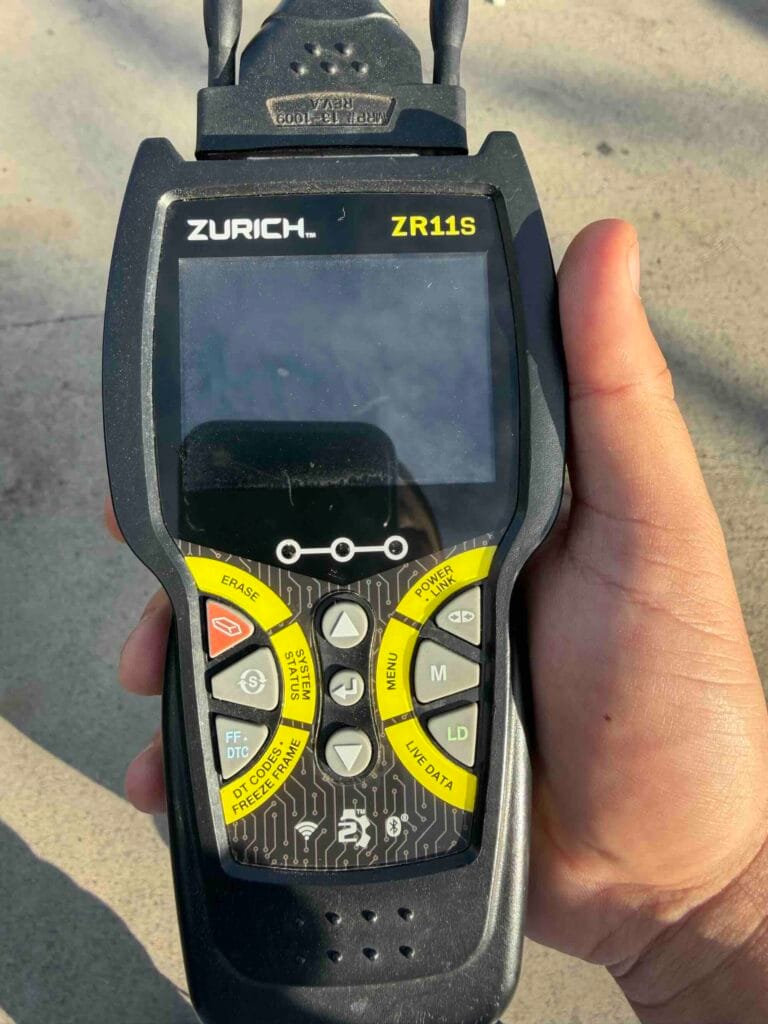
If your check engine light is on and you don’t know what code is causing it, you’re driving blind. It could be something simple, or it could be catastrophic engine failure — and you won’t know until you scan it. Get an OBD2 scanner (about $30-40 at Walmart) or go to AutoZone, O’Reilly, or Pep Boys and they’ll scan it for free. Once you have the code, come back here and find it below.
The Easy Codes — These Barely Affect Your Car’s Value
P0455, P0456, P0440, P0442 — EVAP System Leak
This is the number one thing I see. These codes are almost always caused by a loose, damaged, or dirty gas cap. That’s it. So a gas cap costs just $15 to $20 at any auto parts store, and cleaning the one you have takes about 30 seconds.
If you called me trying to sell a car with one of these codes, I’d be honest with you — I’d tell you it’s probably just a gas cap. If you wanted to keep your car, I’d rather you try that fix first. But if you still want to sell, I’m not going to price it like it’s a junk car over a gas cap code. On a 2004 Toyota Camry with 180,000 miles, I’d pay up to $2,000 if everything else is good. With one of these EVAP codes, I’m still in the $1,400-1,500 range because I know it’s not a serious problem.
P0171, P0174 — System Running Too Lean
This means your engine is getting too much air and not enough fuel. It’s often caused by a dirty mass airflow sensor or a loose vacuum hose. Now cleaning the MAF sensor takes about 5 minutes with a can of MAF cleaner from the parts store. A vacuum hose just needs to be pushed back on or replaced — also cheap and fast.
I’d walk you through this one too. Same pricing as the EVAP codes — I’m not going to crush your offer over something that might cost $10 to fix. But these codes can sometimes point to something more serious, so I’d want to look at the car before I commit to a final number.
P0130, P0155 — Oxygen Sensor
An oxygen sensor code is another one that falls in the simple fix category. The sensor itself usually costs $20 to $80 depending on the car, and replacing it is straightforward. So this code alone isn’t going to make me lower my offer much — it’s a known fix with a known cost.
The Middle Ground — These Make Me Cautious
P0300, P0301-P0306 — Engine Misfire
Now this is where it gets tricky. A misfire code could be as simple as a worn spark plug or a bad coil pack — that’s a relatively cheap fix. But I’ve also seen random misfires turn out to be something much more severe. A head gasket issue, a cracked cylinder, internal engine damage. You don’t always know until you dig in.
So with misfire codes, I have to err on the side of caution. On that same 2004 Camry with 180K, if you’ve got a P0300 or any cylinder-specific misfire, I’m looking at $1,000 to $1,200. That’s lower than the EVAP codes because the risk is higher. It might be a $40 spark plug, but it might be a $2,000 engine problem — and I have to price for the possibility.
Now taking out a spark plug and replacing it isn’t always the easiest thing to do. I know how to do it myself, but not everybody does. So I’d weigh the options for you — I could tell you to go ahead and try replacing the plugs, but I’ve seen scenarios where that doesn’t fix it. If you don’t want to gamble on the repair, that’s where selling to me makes sense.
The Serious Codes — These Drop Your Car’s Value Fast
P0420, P0430 — Catalytic Converter Failing
When I see a P0420 or P0430, that tells me the catalytic converter efficiency is below threshold. This usually means the converter is failing, and it’s often caused by long-term issues like ongoing misfires that were never addressed. Now a catalytic converter replacement in California can run $1,000 to $2,500 or more depending on the vehicle.
This is also the code that will fail your smog test every single time. So if you’re in California and your car has this code, you can’t register it, you can’t sell it private party without putting it on Planned Non-Operation, and the repair bill is steep. That’s exactly the kind of car I buy.
P0011, P0012 — Camshaft Position Timing
These codes point to potential problems with engine timing or oil pressure. And if the timing is off, it can lead to major engine failure. So this isn’t a DIY fix — it needs a mechanic, and the repair cost depends entirely on what’s going on inside the engine.
P0600, P0699 — Computer / PCM Failure
A powertrain control module error means the car’s main computer is having problems. And this can lead to unpredictable behavior — stalling, surging, erratic shifting. Diagnosing PCM issues takes time and specialized equipment, and replacing the module can cost $500 to $1,500 depending on the car.
P0700 — Transmission Control System Malfunction
This is the one nobody wants to see. A P0700 means there’s a serious issue with the transmission that needs immediate diagnosis. And transmission repairs can easily run $2,000 to $4,000 or more. So when I see this code, I know the car needs work.
For all of these severe codes — catalytic converter, timing, PCM, transmission — on that same 2004 Camry with 180K, I’m in the $750 to $1,000 range. Now that might sound low compared to the $2,000 I’d pay without a check engine light, but keep in mind — a junkyard would offer you $400 to $500 for that same car regardless of what code is on it. They don’t care. They’re buying it for parts. I’m paying more because there’s still value in the vehicle beyond scrap.

If Your Check Engine Light Is Flashing — Stop Driving Now
I need to say this clearly. If your check engine light is flashing, not solid — stop driving your car. A flashing light means something is actively damaging your engine right now. So every mile you drive is making it worse. You’re burning the catalytic converter, you’re damaging internal engine components, and you’re turning a repair that might have been $500 into a $3,000 problem.
And if your engine is overheating on top of the flashing light — seriously, pull over and park it. You’re literally burning the engine. Call me from the side of the road if you want — I’ll come look at it wherever it is.
How I Price Your Car vs. How the Junkyard Prices It
Here’s the difference between me and a junkyard. The junkyard is going to offer you $400 to $500 for that Camry whether it’s running perfectly or whether it’s got severe engine codes. They just don’t care about the code — they’re buying it for the headlights, the seats, and the doors. They’re just parting it out.
I price based on what’s actually wrong. So a gas cap code doesn’t cost you $1,000 in value when you sell to me. A misfire costs you some, and a transmission code costs you more. But in every scenario, I’m paying more than the junkyard because I see value in the vehicle beyond parts. Here’s a quick breakdown using that same 2004 Camry, 180K miles:
No check engine light: Up to $2,000
EVAP / gas cap / MAF / O2 sensor codes: $1,400-1,500
Misfire codes: $1,000-1,200
Severe codes (cat, timing, transmission, PCM): $750-1,000
Junkyard offer regardless: $400-500
Every car is different, so these are just ballpark ranges — but that’s how I think through it. Call me with your specific code and I’ll give you a real number.
I Won’t Take Advantage of a Simple Code
I want to be straight about this. If you call me and your check engine light is on because of a gas cap or a dirty MAF sensor, I’m going to tell you that. I’m not going to say “oh, check engine light, that’s going to cost you” and then lowball you. I’ve seen other buyers do that — they hear “check engine light” and immediately slash their offer by $1,000 without even asking what code it is.
That’s not how I operate. I’ll ask you what the code is. If you don’t know, then I’ll tell you how to find out. If it’s a simple fix and you’d rather keep your car, I’ll tell you that too. And even if you don’t want to sell to me at all, call me anyway — I’ll walk you through what your code means and point you toward a good mechanic in your area. I don’t charge for that.
Frequently Asked Questions
Does a check engine light automatically mean my car is junk?
No. Most check engine lights I see are minor issues — gas caps, oxygen sensors, MAF sensors. These are cheap fixes that don’t make your car worthless. The serious codes like catalytic converter failure or transmission problems do lower the value, but even then your car is still worth more than scrap.
Should I fix the check engine light before selling?
It depends on the code. If it’s a $15 gas cap, then fix it — your car’s value goes up way more than $15. But if it’s a $2,000 catalytic converter, you’re probably better off selling as-is and letting the buyer handle it. Call me and I’ll help you figure out which category you’re in.
Will you still buy my car if it has a flashing check engine light?
Yes, but stop driving it first. A flashing light means active damage is happening. Park it and call me — I come to you anywhere in Southern California, so you don’t need to drive it to me.
Can I sell a car with a check engine light in California?
If the check engine light is causing a smog failure, you can’t sell private party unless the car is on Planned Non-Operation. But you can sell to us at goCarBuyer — I handle all the paperwork and you don’t need to worry about smog.
How do I find out what code is causing my check engine light?
Get an OBD2 scanner for $30-40 at any auto parts store, or just go to AutoZone, O’Reilly, or Pep Boys and they’ll scan it for free. The code is a letter followed by four numbers — like P0420 or P0455. Once you have that code, you know exactly what’s going on.
What’s the difference between a solid and flashing check engine light?
A solid light means something needs attention but isn’t an emergency. A flashing light means something is actively damaging your engine right now. Solid — get it checked soon. Flashing — stop driving immediately.
What if my check engine light is on and I lost my title?
Not a problem. I buy cars without titles every single day. I bring the proper California DMV paperwork to you so we can handle it legally and on the spot.
Ready to Find Out What Your Car Is Worth?
Call me with your code and I’ll give you a straight answer. No 20-question forms, no corporate runaround. Just tell me the year, the model, and the code, and then I’ll tell you what I’d pay for it. If it turns out to be a simple fix, I’ll tell you that too — even if it means you don’t sell to me.
I am not a corporate robot. I operate as a family at GoCarBuyer. See what other sellers say on our customer reviews page.
Sonny Miller — (714) 900-3723
GoCarBuyer.com
Cypress Office: 10601 Walker St Suite 102, Cypress, CA 90630
Van Nuys Office: 6360 Van Nuys Blvd #16, Van Nuys, CA 91401
Open 8 AM – 8 PM, 7 Days a Week — Find Us on Google Maps