
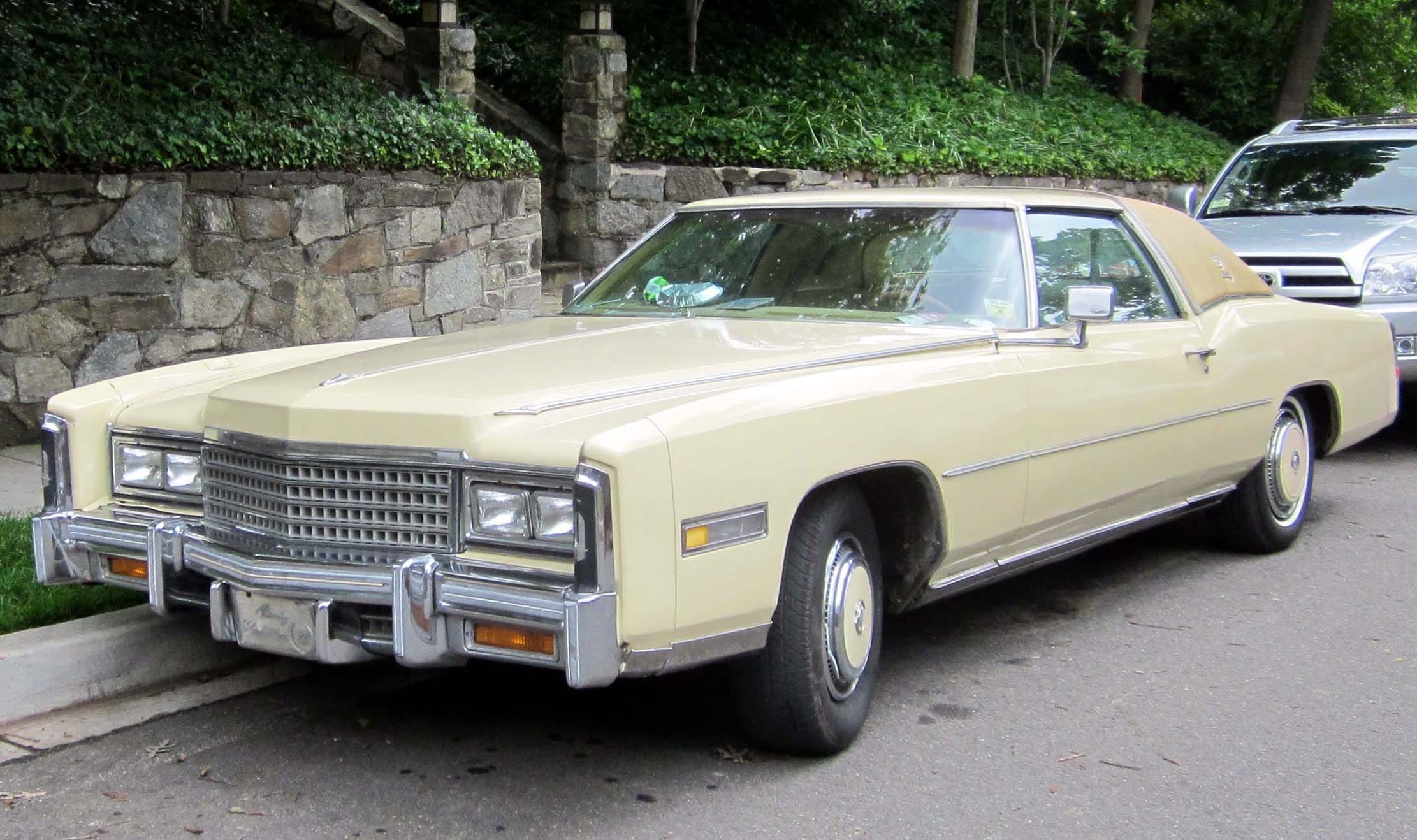
If you’ve got a classic Cadillac and you’re thinking about selling, I want to talk to you before you list it anywhere. My name is Sonny Miller — I’ve been buying classic cars across Southern California for over 20 years, and Cadillacs are cars I know well. I buy every model, every year, every condition. Call me for a free quote — (714) 900-3723. I answer personally and I’ll tell you exactly what your Cadillac is worth.
Watch: How GoCarBuyer Works
What I Need to Know About Your Cadillac
When you call me, I’m going to ask you a few things — year, model, engine, interior condition, and what’s original versus what’s been changed. But there are details specific to each era of Cadillac that affect value, and most sellers don’t realize which ones matter. Here’s what I look for by decade so you know where your car stands.
’40s and ’50s Cadillacs — Fins, Fastbacks, and Hidden Details
If you’ve got a late ’40s Cadillac, you’re sitting on a piece of real automotive history. The 1948-49 body style introduced the very first tail fin on any American car — inspired by the P-38 Lightning fighter plane. These cars also have clever details that add collector value, like the hidden gas cap behind the taillight. Push a button, the taillight pops up, and there’s the fuel filler. Cadillac didn’t want a hole on the side ruining the lines. Whether details like that still work matters when I’m making an offer.
For ’50s Cadillacs, here’s something most people don’t know: Cadillac fins were always perfectly vertical. Never canted in or out. That vertical tail lamp has been a Cadillac signature since 1948 and continues to this day. If your ’50s Cadillac still has the original 390 V8, that adds value. If it has the four-speed Hydramatic transmission — those were used in World War II tanks and they’re basically bulletproof. I buy all ’40s and ’50s Cadillacs regardless of condition.
’60s Cadillacs — Features That Were Decades Ahead
The ’60s are where Cadillac engineering hit its stride. These cars had automatic headlamp dimming, memory power seats on Eldorados, and Cadillac introduced automatic climate control in 1964 — a full year before any other GM division could use it. Ford didn’t get it until 1966. All of this worked mechanically with zero computers. That engineering still impresses today.
The visibility on these cars was so good that some didn’t even come with outside rearview mirrors. The glass area was so large you could just turn your head and see everything — try that in a modern car with thick A-pillars.
When I look at a ’60s Cadillac, interior condition matters above almost everything else. Here’s something that surprises sellers — a Series 62 with perfect vinyl can actually be more desirable than a Coupe de Ville with cracked leather. Vinyl is more durable over decades, so the lower-trim cars sometimes survive in better shape. On the mechanical side, the ’63 was the last year for the 390 V8 before Cadillac moved to the 429. Either engine runs smooth and reliable.
’70s Cadillacs — What Hurts Value and What Helps
The 1970 Fleetwood Brougham rode on a 133-inch wheelbase with a base price of about $7,300 — around $60,000 today. Under the hood, 1970 was the last year for the high-compression 472 cubic inch V8 at 375 horsepower. After that, emissions regulations started choking the power. If your ’70s Cadillac has the pre-emissions engine, that’s a value add.
Here’s what hurts value on ’70s Cadillacs. First, the fake wood trim. By 1970, Cadillac switched from real wood to plastic that looks cheap and fools nobody — not what you expect in a $60,000 car. Second, the 1970 steering wheel is a one-year-only design with inlaid wood that deteriorates badly even on low-mileage cars. If yours is cracked and ratty, that’s normal, but it affects the offer. Third, the door pull straps feel like molded vinyl and don’t close with the quality of a Lincoln from the same era.
On the other hand, the drivetrain on these is excellent. The 472 and 500 cubic inch V8s are smooth and reliable. The automatic rear leveling system used a vacuum pump — you’ll hear a tick-tick-tick under the hood when it’s working. If your rear end sits low, the leveling system probably needs attention, but that’s a minor fix. Later ’70s cars switched to an electric pump.

’80s Cadillacs — The Touring Coupes Nobody Knows About
The ’80s Eldorado Touring Coupe is one of the most underrated Cadillacs. In 1983, Cadillac stripped the chrome, ditched the vinyl roof, went flush-mount on all badging, added bucket seats with a center console — all to compete with the Mercedes 500 SEC and BMW. Only about 1,000 Touring Coupes were sold that year. You can still find these for around $10,000, which is a lot of rare car for the money.
The engine to watch out for in ’80s Cadillacs is the HT-4100 — the “High Technology” 4.1-liter V8. It had digital fuel injection that was advanced for its time, but reliability was not its strength. If your ’80s Cadillac runs the HT-4100, that factors into value. The later 4.5 and 4.9 engines were significantly better.
’93-’96 Fleetwood — The Last Body-on-Frame Cadillac
The 1993-96 Fleetwood Brougham deserves its own section because it’s the last real full-size, rear-wheel-drive, body-on-frame Cadillac. The ’93 carried over the old 5.7-liter V8 at just 185 horsepower. Then in 1994, Cadillac dropped in the LT1 — the same engine from the Corvette — and output jumped to 260 horsepower. These LT1 Fleetwoods can smoke the tires and do 0-60 in about 7 seconds despite weighing over two tons.
If you’re selling a ’94-’96 Fleetwood, I want to know about the LT1 — that’s a significant value difference over the ’93. The one known weak point is the Optispark distributor sitting right next to the water pump. When it fails, it’s an $800-900 repair. Don’t bother fixing it before selling to me — I factor that in. These Fleetwoods also had a 7,000-pound towing capacity with the HD trailer package, and the LT1 versions get 25+ miles per gallon on the highway. The Brougham package also came with a shorter rear-end ratio, giving you slightly better acceleration.
One thing that did suffer on these was interior quality. GM lost record money in 1992 and started cutting costs across the board. The Fleetwood’s interior materials feel plasticky compared to the previous generation — same issue hit the Buick Roadmaster and Chevy Caprice. If yours has a well-maintained leather interior despite that, it’s worth more.
Resto-Mod Cadillacs — What Works and What Doesn’t
I buy a lot of modified Cadillacs, and some builds add real value while others kill it. A well-done resto-mod with a Cadillac 500 cubic inch big block in a late ’40s body can work beautifully — the 500 is the biggest V8 Cadillac ever put in a passenger car and it sounds like a yacht. Pair it with a TH400 transmission, disc brake conversion, modern cooling, and power steering — that’s a build done right.
Air ride rear suspension is common on resto-mod Cadillacs. Here’s what most sellers don’t realize — these systems slowly lose air even when they’re brand new. If your car sits low in the back, it probably just needs a top-off through the Schrader valve, not a whole new system. However, if the car sat for years with collapsed air ride, the suspension may have been bottoming out on the rear axle. I check for that wear.
What kills value: modern stereo heads that don’t match the dash, cheap interior swaps, and wrong-brand engine swaps. A Northstar-powered ’49 Cadillac sold on Bring a Trailer for $99,000 — but Northstars are unreliable and the next buyer knows it. Meanwhile, a ’41 Cadillac with an LS swap sold at Barrett-Jackson for half a million. The quality and appropriateness of the build is everything.
Original vs. Restored — What Brings More Money
Original unrestored Cadillacs in good condition almost always bring more than restored examples. When someone takes a car apart, things get screwed up — gaps change, trim doesn’t sit right, paint doesn’t match. An original car with proper storage and a considerate owner has a quality no restoration can replicate.
Sometimes a repaint makes sense — if the paint is sand-blasted from highway driving or chunks are falling off from a factory prep issue. But the key is keeping everything else untouched. Original interior, original chrome, original vinyl top. A one-repaint car that’s otherwise original still counts as a survivor.
Storage history matters as much as mileage. Mountain and desert cars — Colorado, Arizona, inland California — survive incredibly well. Low humidity keeps interiors crisp, chrome bright, and bodies clean. A 50,000-mile Cadillac from Colorado can look better than a 20,000-mile car from a humid climate.
Why Sell Your Classic Cadillac to GoCarBuyer
I come to you — your garage, your storage unit, your driveway. I pay cash or check on the spot. Even if you lost the title, I handle all the DMV paperwork. No smog issues, no back registration, no hassle. Whether you’re in Los Angeles County, Orange County, Riverside, San Bernardino, San Diego, or Ventura County — I come to you within hours.
Frequently Asked Questions About Selling Your Classic Cadillac
What Cadillac models do you buy?
Every model — Series 62, Coupe de Ville, Sedan de Ville, Eldorado, Fleetwood, Fleetwood Brougham, Seville, Calais, Sixty Special, Eldorado Touring Coupe. From the ’40s through the ’90s, any condition.
My Cadillac has been modified. Do you still buy it?
Yes. Resto-mods, engine swaps, air ride, disc brake conversions — I buy them all. The value depends on the quality of the build.
Is my ’94-’96 Fleetwood with the LT1 worth more than a ’93?
Yes. The LT1 makes 260 horsepower versus 185 in the ’93. That’s a big difference in both performance and value.
Should I fix the Optispark before selling?
No. I factor known issues into my offer. Spending $800-900 on a repair won’t add that much to the sale price. Sell it as-is.
My Cadillac has been sitting for years. Is it still worth something?
Absolutely. Barn finds and garage finds are some of my favorite deals. Dead battery, flat tires, collapsed air ride — none of that matters to me.
How fast can you come look at my Cadillac?
Usually within hours. I serve all of Southern California — LA, Orange, Riverside, San Bernardino, San Diego, and Ventura counties.
Ready to Sell Your Classic Cadillac?
Call me and tell me what you’ve got. I’ll give you a straight answer on what it’s worth. See what other Southern California car owners say on our customer reviews page.
Sonny Miller — (714) 900-3723
GoCarBuyer.com
Cypress Office: 10601 Walker St Suite 102, Cypress, CA 90630
Van Nuys Office: 6360 Van Nuys Blvd #16, Van Nuys, CA 91401
Open 8 AM – 8 PM, 7 Days a Week — Find Us on Google Maps