


There’s a reason you see Camrys on the road with 300,000, 400,000 miles still going to work every morning. Toyotas just keep running. And because of that, your Toyota is probably worth more than you think — even with high miles, even with a check engine light, even with a dent or two.
So if you’ve got a Toyota sitting in your driveway and you’re not sure what to do with it, I want to help you figure that out. My name is Sonny Miller — I’ve been buying cars across Southern California for over 20 years, and Toyotas are some of the most common vehicles I deal with.
Whether you end up selling to me or not, I’m going to give you honest advice that’ll help you get the most for your car. And if you just want a straight answer on what yours is worth, call me anytime at (714) 900-3723 — I pick up personally, no pressure, no obligation. Keep reading for the tips.
Watch: How GoCarBuyer Works
Why Toyotas Hold Value Better Than the Competition
I’ll put it to you this way. The Nissan Altima? Great car when it’s new, but the transmission is basically a ticking clock — I’ve talked to owners who’ve been through three or four of them before 200,000 miles. Same thing with the Honda Accord? Solid car, but the older 2.4s leak oil from the VTEC solenoid constantly and some of them blow head gaskets earlier than they should.
Now the Toyota — the one thing people bring up is the oil consumption on the 2.4-liter engine. That’s it. One known issue. But the transmissions almost never give you trouble. The engines just keep going with basic maintenance. So I’ll take one known quirk over a list of problems any day.
And here’s what that means for you — because Toyotas have that reputation for lasting forever, buyers are willing to pay more for them in the used market. A Camry with 150,000 miles still has a lot of life left and the market knows it. A Tacoma with 200,000 miles? People line up for those. So if you’ve been looking at your old Toyota thinking it’s not worth much — give me a call and let me give you a real number. You might be surprised.
What Toyotas I Buy and What Affects Their Value
I buy every Toyota model. But I wanted to break down the ones I see the most and tell you what I look for on each one — that way you know where your car stands before you even pick up the phone.

Toyota Camry
This is the car I buy the most, hands down. I see more Camrys than probably any other single model in Southern California. Now, the thing everybody talks about is the oil situation on the 2.4-liter engine. Here’s what you should know — there’s two versions of that engine. The older ones that run 5W-30 oil have a milder version of the issue. But the newer ones that switched to 0W-20, roughly 2008 and later, those tend to go through oil faster.
What happens over time is the rings wear and oil gets past them into the engine. It’s not a death sentence though — if you keep an eye on your oil level and change it every 3,000 to 5,000 miles instead of 10,000, these engines go a very long time. In fact, Toyota-only shops tell me they see this generation Camry come in with over 400,000 miles and the original transmission still shifting fine.
Other Common Camry Issues
Other stuff I see on Camrys — oil leaking from the valve cover gasket at higher miles, which is a pretty straightforward fix. Sometimes there’s a rattle noise from the intake area that’s not really hurting anything, just annoying. Also, check engine lights from the emissions canister, usually a code starting with P0440, P0442, or P0446 — and honestly, before you spend any money, check your gas cap first. I can’t tell you how many times a loose gas cap triggered a check engine light.
Another thing — on the 2007 to 2011 Camrys, the engine mounts get soft at higher mileage and you’ll feel more vibration than you should. And if you’re here in Southern California, you’ve probably noticed the dashboard cracking from the heat — that’s common on this generation too. None of this kills the car’s value though. Call me and I’ll tell you what it’s actually worth with whatever it’s got going on.
One more thing — if you’re deciding between the four-cylinder and the V6, the four-cylinder is the one everybody wants because the gas mileage is so much better. You’re looking at 30-plus miles per gallon versus maybe 19 or 20 with the V6. I buy both, any year, any trim, any condition.
Toyota Tacoma
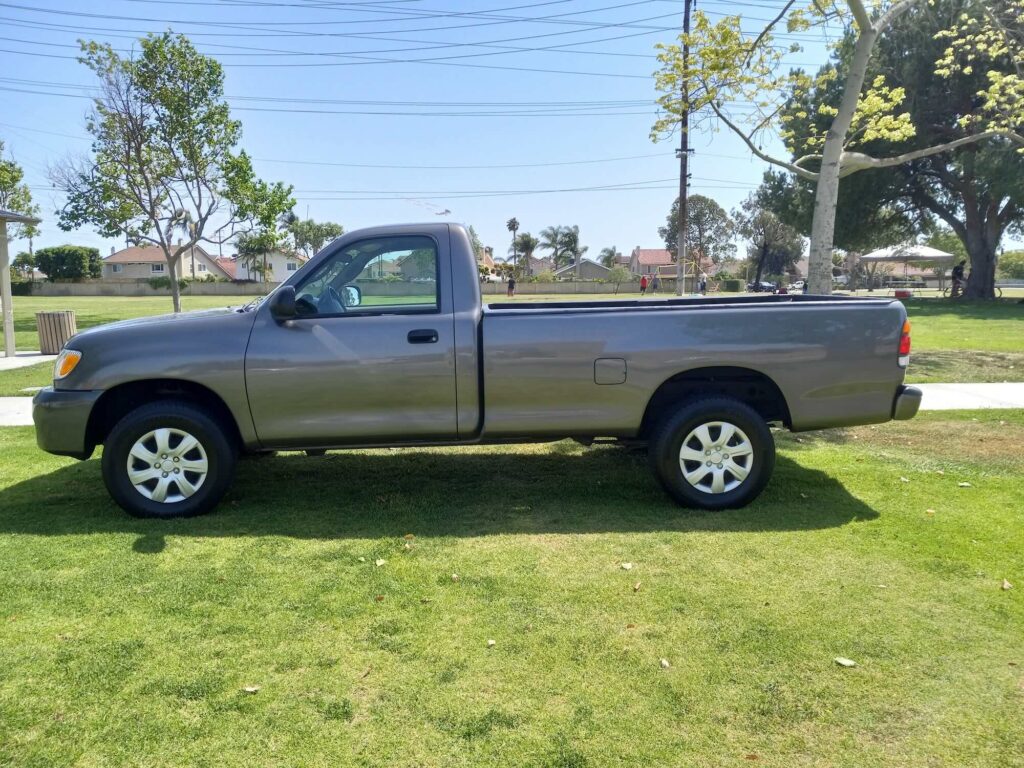
Tacomas are probably the best trucks out there for holding value. The issue that a lot of people already know about is the frame rust situation. What happened is the frames on certain years didn’t get coated properly during manufacturing, and over time rust developed in places it shouldn’t have. Toyota stepped up and did a recall — depending on how bad it was, they either cleaned it up and sealed it or replaced the entire frame. If you’re not sure whether yours was covered, check your VIN with any Toyota dealer. They’ll tell you if there’s still an open recall.
Now, the other thing I always tell Tacoma owners to watch for is the front suspension. The lower ball joints in the front carry a lot of weight — the whole wheel, the steering, everything rides on them. When they start wearing out, you do not want to ignore it. I’ve heard stories of guys driving on the freeway and the whole front wheel just tucks under into the fender because the joint let go. That’s a safety issue, not just a maintenance thing. So if you see grease leaking from the boots or feel any looseness in the steering, get it looked at or just call me and sell it.
In addition to that, the starter tends to need replacing somewhere in the 200,000-mile range, which honestly for any other truck would’ve happened a lot sooner. And on the second-generation trucks, the rear suspension can sag if you’re loading it heavier than the base model was designed for.

Toyota 4Runner
4Runners are in a league of their own when it comes to resale. People love these trucks and the prices reflect that. But the 2003 to 2009 models have a few things that come up. The exhaust components near the engine tend to deteriorate over time, and because the catalytic converters are attached to that assembly, replacing them gets pricey.
On top of that, the 4.0-liter V6 can have cooling issues once you get past about 125,000 miles — the signs are overheating without any coolant on the ground, white smoke from the exhaust after sitting overnight, or a gurgling sound from inside the dash. That gurgling is basically air getting into the cooling system where it shouldn’t be.
Now, here’s a tip that could save you a lot of money. If your AC suddenly quits and the light on the climate controls is blinking at you, don’t let anyone tell you it’s a $1,500 compressor job. Nine times out of ten, it’s a $20 relay in the fuse box. Swap it and the AC works again. Another thing — Toyota recalled the Tacoma frames but never did the same for the 4Runner, even though the frames are basically identical. That’s frustrating for 4Runner owners, but it’s something I factor into my offer. I still buy them with frame issues — just call me and describe what you’ve got.
Toyota Sequoia
The Sequoia is a big, heavy truck and that weight shows up in certain ways. First off, there was a recall on the front suspension joints — they can fail at highway speed, which is about as serious as it gets. If you own a Sequoia, you need to check your VIN with Toyota to make sure that’s been taken care of. In addition, the exhaust manifolds tend to develop small cracks over time — you’ll notice a ticking sound at startup that sometimes goes away once the engine warms up.
Also, front brakes wear faster than you’d expect because the truck is so heavy and the caliper hardware tends to seize up, especially in anything other than perfect conditions. And if your ABS and stability control lights come on together, that’s usually a sensor underneath the center console — it’s pricey from Toyota but it’s something you can swap out yourself with basic tools if you’re handy.
Toyota Corolla
Corollas are about as close to indestructible as a car gets. But the 2002 to 2008 models have one thing I see come up — a slow oil leak from the side of the engine that can cause the timing chain to get noisy over time. It’s an oil-pressure issue. If the leak goes on long enough without being addressed, the chain doesn’t stay tight and you’ll hear a rattle when the engine is running. Usually the first step is just checking the oil level and doing a fresh oil change — sometimes that’s all it takes.
The idle can also get a little weird at stoplights, surging up and down, which is usually a dirty screen behind a small plug on the engine that needs to be cleaned out. As far as other common stuff goes, starters tend to wear out after about 100,000 miles, and the headlights yellow and haze over — but that’s every car with plastic lenses, not just Corollas. I buy all of them because they’re some of the easiest cars to resell — the demand never stops.
Toyota Prius
I get asked all the time — is a Prius with a dead hybrid battery still worth anything? Yes. I still buy them. Now, the 2010 to 2015 models have a few things that come up. For one, the touchscreen display in the center can stop working — it’s a manufacturing quality issue with the internal connections, not something you caused. Also, the fuel gauge can read wrong, which is annoying because you never really know how much gas you have. And the EGR system gets clogged with carbon buildup over time and triggers a check engine light.
But the big one to watch is the water pump — unlike a normal water pump that leaks or makes noise before it fails, the Prius water pump just goes out with no warning other than a check engine light. If you keep driving with that light on, you can overheat and ruin the engine. But even with a bad battery or a blown engine, your Prius has value. Don’t scrap it — call me first.

RAV4, Highlander, Tundra, and Others
I buy every Toyota model — RAV4s, Highlanders, Tundras, Siennas, Venzas, Land Cruisers, FJ Cruisers, Matrix, Yaris. Every year, every condition. The RAV4 and Highlander are two of the most popular SUVs in Southern California and they hold value well. Tundras are workhorses that just keep going. If it says Toyota on it and you want to sell it, I’m interested.
Tips Before You Sell Your Toyota
Whether you sell to me or sell privately, here’s some stuff that’ll help you get more money for your car.
First — if you’ve got a check engine light, don’t just assume the worst. Instead, pick up an OBD2 scanner at Walmart for about $30-40, or go to AutoZone or O’Reilly’s and they’ll scan it for free. You’d be surprised how often it’s something simple like a gas cap that needs replacing for $15, or an oxygen sensor that’s gone bad. If the code comes back as something cheap, fix it — your car is worth more with the light off. But if it’s something expensive, don’t throw money at it. Just sell it as-is. That’s what I’m here for.
Second — clean the car. I know it sounds basic but you’d be amazed at the difference. Wash it inside and out, get the stains out of the seats, wipe down the dash. Even just five to ten bucks for some Armor All on the tires and the whole car looks like somebody cared about it. Also, take 50 to 100 photos — good angles, the interior, the engine bay, a shot of the mileage on the odometer. If you’re selling privately, spend $40 on a Carfax and send it to anyone who asks. It takes all the guessing out and helps the sale go a lot faster.
Third — have realistic expectations on price. Dealerships list that same Camry for $7,000 because they offer financing and a warranty. You’re not a dealership. So if you can get $4,500 to $5,000 for that car selling private party, you’re doing well. Price it too high and it’ll sit there for weeks while scammers waste your time on Facebook and Craigslist.
Don’t Want to Deal With Selling Privately?
I get it. The lowballers, the scammers sending you fake VIN verification links, the no-shows, the hundred questions — how many miles, does it pass smog, is it smogged, what’s wrong with it, can I test drive it. It gets old fast, trust me. So with me, you skip all of that. One phone call, I give you a fair quote, and if we’re close, I come to you. In addition, I handle all the paperwork — you don’t have to go to the DMV. You lost the title? That’s okay, I take care of it. Your Toyota doesn’t pass smog? Doesn’t matter. Registration is expired? Not a problem.
Whether you’re in Los Angeles County, Orange County, Riverside County, San Bernardino County, San Diego County, or Ventura County — I come to you. Your home, your office, your driveway, wherever the car is. I work 7 days a week, and if you need me there late in the evening, I’ll make it work. Cash or check, whatever you prefer. And if the vehicle is not a fit for us, I’ll tell you — I will not waste your time, but I’ll at least try to guide you in the right direction.
Frequently Asked Questions About Selling Your Toyota
My Camry burns oil. Do you still buy it?
Yes. The oil consumption thing on the 2.4-liter is well known and it doesn’t scare me off. I factor it into the offer. Don’t spend money trying to fix the rings before selling — just sell it as-is.
My Tacoma has frame rust. Does that affect the price?
It can, depending on how bad it is. Check your VIN with Toyota first — there might still be an open recall where they’ll take care of it for free. Either way, I still buy Tacomas with frame issues.
My 4Runner needs a head gasket. Should I fix it first?
No. That’s an expensive job and you’re not going to get that money back in the sale price. Sell it as-is. I buy 4Runners with engine problems all the time.
My Prius hybrid battery is dead. Is it still worth something?
Yes. Even a Prius with a dead battery or a blown engine has value. Don’t scrap it — call me first.
Do I need to fix the check engine light before selling?
Only if it’s something cheap — a gas cap, a sensor, a loose connection. If the repair is expensive, leave it. I factor known issues into my offer so you don’t have to spend money to make money.
How fast can you come look at my Toyota?
Usually within hours. I serve all of Southern California 7 days a week, including evenings.
Ready to Sell Your Toyota?
Call me and tell me what you’ve got — year, model, miles, what’s going on with it. I’ll give you a straight answer on what it’s worth. No games, no runaround. Even if you just have questions about your car’s value or need help figuring out the best way to sell, I’m here. I am not a corporate robot. I’m a Southern California resident just like you, and I’ve been doing this for over 20 years. See what other car owners say on our customer reviews page.
Sonny Miller — (714) 900-3723
GoCarBuyer.com
Cypress Office: 10601 Walker St Suite 102, Cypress, CA 90630
Van Nuys Office: 6360 Van Nuys Blvd #16, Van Nuys, CA 91401
Open 8 AM – 8 PM, 7 Days a Week — Find Us on Google Maps


