

Hey, it’s Sonny. From Long Beach to Riverside, I hear the same worry every week: what’s this title transfer going to cost me? Somebody heard fifteen dollars, somebody else got a four hundred dollar surprise at the counter, and now nobody trusts any number. So let me lay out the whole bill the way I explain it at kitchen tables across Anaheim and the Inland Empire. Because the truth is simple: the transfer fee itself is small, and everything expensive rides in with it. Once you know which lines apply to you, there’s no surprise left. And if you’d rather skip the counter completely, call me at (714) 900-3723. I pick up personally.
$15. The transfer fee. The rest of the bill is the story.
The one honest number: fifteen bucks
The DMV’s fee for transferring a California title is fifteen dollars. That part of the rumor is true. If the car’s registration is current, the smog box is checked, and you file on time, the paperwork itself costs less than lunch for two. So why do people walk out hundreds lighter? Because the transfer fee is the ticket, not the ride. Three other lines decide your real total, and here’s each one in plain English.
The line that dwarfs everything: use tax
California treats a private party sale like a store purchase, so the buyer owes use tax on the price. The statewide base is 7.25 percent, and district taxes stack on top depending on where the buyer lives, which pushes many SoCal addresses toward 9 or 10 percent. Notice I said where the buyer lives. The rate follows the buyer’s home address, not the seller’s, and the DMV collects it right at transfer. On a $6,000 car, that’s roughly $500 before anything else. Also, don’t get cute with the number. Write a lowball price on the paperwork and the state compares it against the car’s value, then taxes what it believes, not what you wrote. Honest numbers move faster.
Smog: who pays, and the cheap exception
Most transfers need a smog certificate, and that bill belongs to the seller. Figure about fifty bucks at most shops, actually closer to seventy at some stations around here, and the certificate stays valid for 90 days. But there’s a nice exception: if the car is four model years old or newer, no inspection happens and the buyer just pays an $8 smog transfer fee instead. Gas cars from 1975 or older skip smog entirely. And if the car already failed the test, a normal private sale gets complicated fast. That exact headache is why I wrote a full guide on selling a car that failed smog in California, and it’s a situation I buy through every single week.
The ambush: expired registration
Here’s the trap that creates those four hundred dollar stories, you guys. Transferring the title and renewing the registration are two different things, but the DMV settles both accounts at the same window. So if the registration lapsed while the car sat in a driveway, all the back fees and penalties come due at transfer: the registration fee, the CHP fee, the Vehicle License Fee based on the car’s value, and sometimes lines like the Transportation Improvement Fee. Penalties grow with every month of delay, and the DMV offers no grace period at all. One protection worth knowing: if you bought the car without knowing the old fees were unpaid, the DMV can waive the penalty portion when you explain it on a Statement of Facts. My REG 256 guide shows exactly where that goes on the form.
The self-inflicted one: filing late
The clocks are short. Sellers file the release of liability within 5 days, and buyers report the transfer within 10 days of the sale. Miss the window and transfer penalties start stacking on top of everything above. Late fees are pure waste, the only line on the bill that buys you absolutely nothing. So file the same week, even if the car needs work before it drives.
Who pays what
Custom in California splits the bill cleanly. The seller pays for the smog inspection and delivers a clean title. Then the buyer pays the $15 transfer fee, the use tax, and any registration that’s due. Everything is negotiable in a private deal, sure, but that’s the split the DMV’s own process assumes, and it’s the one most buyers expect when they show up with cash.

Gifts and family transfers
A true gift owes no use tax, whether it goes to family or a friend. The moment money, trade, or a loan takeover enters the picture, though, it stops being a gift and the tax comes back. Family sales get their own break: transfers between parents, children, grandparents, grandchildren, spouses, and domestic partners skip the use tax with the right paperwork. Siblings only qualify while both are under 18, which surprises people constantly. Either way, the claim rides on a Statement of Facts filed with the title.
Know your exact number before you go
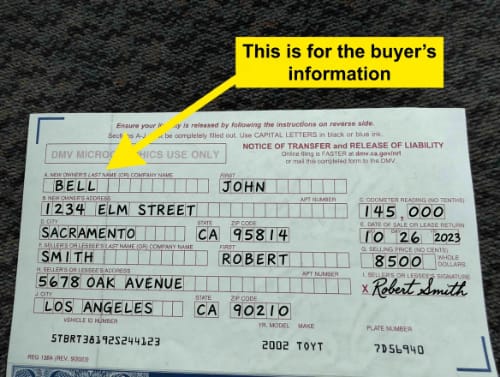
Every car lands differently because the value, the county, and the registration status all move the total. So before anyone drives anywhere, run the DMV’s own fee calculator. Two minutes with the VIN and the price gives you a ballpark figure you can actually plan around, and it beats every estimate a stranger on a forum will give you. While you’re at it, my walkthrough on how to fill out a California title shows where every signature and the odometer reading go, since a rejected form costs you a second trip.
Selling? Here’s how to keep the buyer’s bill small
An honest tip from my side of the table, because a cheaper transfer sells your car faster. First, renew the registration if it’s expired, or price the car knowing the buyer eats those back fees. Second, get the smog done before you list, since a fresh certificate removes the biggest buyer excuse. Third, have the title ready, because a lost title means a replacement application first, and my REG 227 guide walks that whole road. Fourth, meet the buyer at AAA or the DMV and finish the transfer together. Ten extra minutes protects you both.
Title transfer questions I hear every week
Or make the whole bill my problem
When I buy your car, the transfer costs you nothing. No smog run, no counter, no fees, because the buyer’s side of the deal is mine to handle, and handling it is literally my job. I bring the paperwork, I pay you on the spot, and I file the release of liability before I leave your driveway. That’s super, super simple compared to a Saturday at the DMV. I cover Orange County, LA, the San Fernando Valley, and the Inland Empire, seven days a week, 8 AM to 8 PM. Cypress office: (714) 900-3723. Van Nuys office: (818) 405-8808. Call either one and you get me, and I’ll give you a fair quote or point you somewhere better, whichever the facts call for.