

Every week somebody calls me mid-search, frustrated. They’re selling a car with a lost title, the DMV said bring a REG 262, and Google served up a dozen sites offering a “fillable REG 262 PDF.” So they printed one, drove to the window, and the clerk turned them away. Here’s the truth those sites won’t lead with: you cannot download the REG 262, and the DMV will never accept a printout or photocopy of it. I’m Sonny Miller, I buy cars across LA and Orange County, and this form rides along with half the lost-title vehicles I purchase.
Call me at (714) 900-3723 if one of those is sitting in your driveway. And keep reading, because getting the real form takes ten minutes once you know where it lives.
Why there’s no PDF of the REG 262
The REG 262, the Vehicle/Vessel Transfer and Reassignment Form, carries a federal odometer disclosure. And federal law, specifically 49 CFR Part 580, requires odometer disclosures to live on tamper-resistant documents. So the DMV prints the 262 on security paper, the same idea as a check or a title, with features a home printer can’t reproduce. A PDF version would defeat the entire point.
That’s why the “fillable REG 262” sites are selling you a rejection. The file opens, the fields fill, and the counter clerk hands it back.
You’ll even find genuine-looking PDFs of the form floating around, because insurance companies host copies for their own total-loss paperwork. But the form’s own header settles it, in capital letters across the top: PHOTOCOPIES NOT ACCEPTED. A home printout of any PDF, real or fake, is a photocopy in the DMV’s eyes, and only the original security-paper sheet counts. Some sites even sell hard copies of a form the DMV gives away free. Don’t pay anyone for this paper, and don’t print it either.
Three documents in one
The 262 earns its security paper by doing triple duty. It’s an odometer disclosure, a bill of sale, and a power of attorney on a single sheet. One form, both signatures, and the DMV gets everything it needs to move ownership when the title alone can’t tell the whole story.
When you actually need one
The big one is a lost-title sale. When the title is gone and the transfer runs on an Application for Duplicate Title, the REG 227, there’s no title to carry the odometer disclosure. So the REG 262 carries it instead, and the two forms travel together. If you’re selling a car without a title, expect this pairing.
You also need it when a title is noncomplying or has no valid space for the odometer disclosure, which happens with some older and out-of-state titles. And it steps in when the reading already on a title is wrong, or when somebody altered it, because the 262 sets the record straight with both parties signing behind it. Dealers use it constantly for reassignments, which is why every dealership has a pad of them.
Now the flip side, because plenty of sellers don’t need it at all. A vehicle from model year 2010 or older is exempt from the federal odometer disclosure. So for those, a REG 135 bill of sale and a REG 260 power of attorney cover the same jobs, and both of those download free like normal forms.
How to get the real one, free
Walk into any DMV field office and ask for a REG 262 at the forms rack or the window. You don’t need an appointment when you’re only grabbing a form. Can’t make the trip? Call the DMV at 1-800-777-0133 and ask about having one mailed. Dealerships and some credit unions also keep them on hand. The full list of which forms download and which don’t lives on the DMV’s forms page.
And here’s the tip that saves a second trip: take two copies. You’ll see why in a minute.
Filling it out, section by section
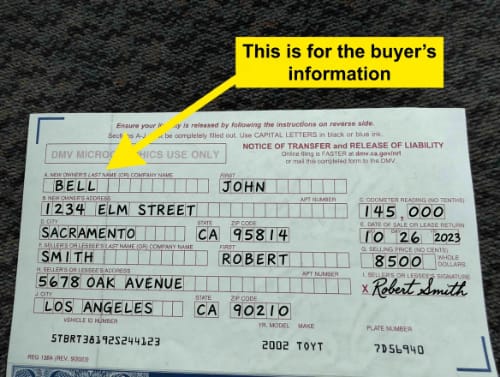
Since I can’t legally hand you a sample of security paper, here’s the next best thing: all five sections of the form, walked through the way I’d do it on a tailgate. One rule sits above everything, printed right in the form’s own header: every signature must be in ink, and the DMV takes no photocopies.
Section 1: the vehicle or vessel description
Copy the identification number character by character, then the year, make, and license plate, or the CF number if it’s a boat. These must match DMV records exactly, because a transposed digit here kicks the whole transfer. Pull the VIN from the dash plate or door jamb sticker, not from memory.
Section 2: the bill of sale
The sellers’ and buyers’ printed names, the date of sale, and the amount paid. This is the line the DMV figures use tax from, so it needs to be the honest number, and a suspiciously low figure invites questions. If it’s a gift instead, the form asks for the relationship, parent, spouse, friend, plus the gift’s value, and that’s also your cue to read up on the REG 256 Statement of Facts, since gift tax exemptions run through it.
Section 3: the odometer disclosure
The form prints its own warning here: void if mileage is altered or erased. So enter the exact reading off the dash, no rounding, no tenths, and touch nothing twice. If anyone ever replaced the cluster or the mileage rolled past its limits, check the discrepancy box that fits instead of writing a clean-looking number, because federal and state law back this section with fines and imprisonment for false statements.
High mileage itself scares nobody, by the way. I buy high-mileage vehicles every week, and an honest 240,000 beats a fishy 140,000 every time.
Section 4: buyer and seller
Both parties complete this one, and the form is strict about it: hand print the name, date it, and sign. The buyer signs first and acknowledges the odometer reading along with the facts of the transfer, under penalty of perjury. Then the seller certifies the same way. Each signer adds a driver license or ID number and a mailing address that match DMV records to the letter, because the gym-membership version of your name doesn’t count here.
Section 5: the power of attorney
This block only matters if someone is signing documents on your behalf, and most private sales skip it entirely. But if you’re appointing someone, both printed names go in, and the person granting the power signs.
And this is where the two-copies tip pays off, because security paper forgives nothing anywhere on the page. No white-out, no cross-outs, no erasing. One slip of the pen voids the sheet, and you start fresh on copy number two instead of driving back for one.
Want all of this on one page for the DMV trip? Download my free REG 262 Quick Guide: when you need it, where to get it free, and the five rules before you write, on a single printable sheet.

When a different form does the job
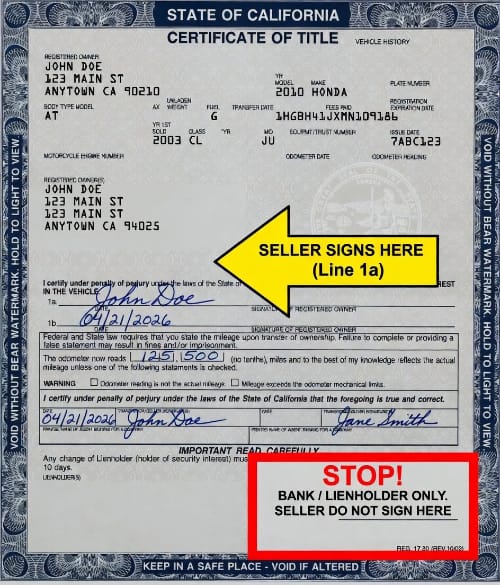
Clean title sitting in your hand on a newer vehicle? Then the title itself carries the odometer disclosure and the transfer sections, and my guide on how to fill out a California title walks every line. Explaining a special circumstance to the DMV, like a tax exemption or a smog question, is a REG 256 Statement of Facts job. And if the vehicle is entering California for the first time, from another state or back from salvage, the transfer isn’t the issue at all. That starts with the REG 343, covered section by section in my fill-out guide.
What sellers ask me about the REG 262
Can I download the REG 262 anywhere?
No. The DMV prints it on security paper to satisfy federal odometer law, and it publishes no PDF. Any site claiming otherwise is offering a form the counter will reject.
I found a fillable REG 262 online. Will the DMV take it?
It won’t, and that’s true even if the PDF is a scan of the real form, like the copies insurance companies host for claims paperwork. Printouts and photocopies fail the security features on sight. The only valid REG 262 is an original sheet from the DMV, a dealer, or another official source.
What happens if I make a mistake on it?
The form is done. You can’t correct security paper with white-out or cross-outs, so a mistake means starting over on a fresh copy. That’s why I tell everyone to pick up two.
Do both the buyer and seller have to sign?
Yes. The odometer disclosure requires both signatures to be valid, and an unsigned line sends the whole packet back.
My car is a 2008. Do I still need a REG 262?
Probably not. Vehicles from model year 2010 and older are exempt from the federal odometer disclosure, so a downloadable REG 135 bill of sale and REG 260 power of attorney usually cover the same ground. The exception is a lost-title transfer, where the DMV may still want the 262 alongside the REG 227.
Does selling to a dealer or a buyer like you skip all this?
It shifts the work, not the requirement. When I buy a vehicle, I bring the paperwork, including the 262 when the situation calls for it, and we complete it together on the spot. You sign, I handle the rest.
The short version
The REG 262 is the one DMV form you fetch instead of print, because federal odometer law demands paper nobody can fake. Grab two copies free from any DMV office, fill it in ink with numbers that match reality, and get both signatures on the odometer line.
So if the form entered your life because of a lost title, a dusty older car, or a transfer that got complicated, there’s a simpler path: I deal with this form every week, and when I buy your vehicle, the paperwork is my problem. I’m a SoCal resident just like you, I answer personally, and I’m not a corporate robot. Cypress office: (714) 900-3723. Van Nuys office: (818) 405-8808. Open 8 AM to 8 PM, 7 days a week. If it’s not the right fit, I’ll lead you in the right direction.