

Somebody says “make sure you get a bill of sale,” and the search that follows lands you in a swamp of template sites charging for a document California hands out free. So here’s the part they bury: the official California bill of sale is DMV form REG 135, it downloads free, it never needs a notary, and you can fill it out in about four minutes.
I’m Sonny Miller, I buy cars from Long Beach to Riverside, and a bill of sale crosses my tailgate on nearly every purchase. Call me at (714) 900-3723 if the car behind the paperwork is one you’d rather just sell. And keep reading, because a couple of lines on this little form decide your taxes and your liability.
Do you even need a bill of sale in California?
Sometimes the law requires it, and the rest of the time you want it anyway. The DMV demands one when the person selling the vehicle is not the owner named on the title, and in that case both the seller and the person on the title sign it. The DMV can also ask for one when the buyer registers a private-party purchase, and vessel transfers lean on it constantly. Dealer sales skip it, since the dealer’s paperwork covers the same ground.
Beyond the requirements, the form protects both sides for free. The seller gets dated proof the car changed hands, which matters when a parking ticket shows up three months later. And the buyer gets a receipt with the price, the VIN, and a signature under penalty of perjury. Here’s the rule almost nobody quotes, straight from the DMV’s own registration manual: any bill of sale that identifies the vehicle is acceptable. The REG 135 is simply the official version that gets every required line right on the first try.

Get the official form free, and skip the template sites
The REG 135 downloads free from the DMV, and here’s a twist worth knowing: it’s the mirror image of the security-paper transfer form. The DMV posts the 135 on its website only and doesn’t stock it at field offices, so your printer is the supply chain. The sheet prints two identical copies per page with a cut line between them, one for the buyer, one for the seller. Print it, cut it, done. Anyone charging you for a “California bill of sale template” is selling a worse version of this free PDF.
Filling out the REG 135, line by line
The form is one short page, but three of its lines carry real consequences. So here’s each one, the way I’d walk you through it on the hood of the car.
The vehicle description
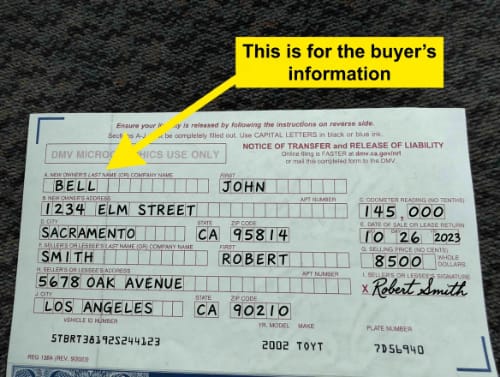
Copy the VIN character by character from the dash plate or the door jamb sticker, then the year, make, and license plate. A CF number goes in the plate box for a boat. One transposed digit here and the DMV can’t match the paper to the vehicle, so this row earns a double check.
The seller and buyer names
The I/We line takes every seller’s name, printed exactly as it appears on the title. Then the buyer’s full legal name goes on the line below, written the way the new title should read. And if the person selling isn’t the name on the title, both names belong on the seller line, because both of them sign at the bottom. More on that trick in a minute.
The date and the amount
The date boxes start two clocks: the buyer’s ten days to transfer the title, and the seller’s five days to file the release of liability. Then comes the line that matters most, the selling price. The DMV figures the buyer’s use tax from this number, so it must be the honest one. A suspiciously low figure invites a DMV value review, and that delay costs more than the tax ever would.
The gift line
A genuine gift gets the relationship written in, parents, spouse, friend, plus the vehicle’s honest value in the gift box. That relationship line is what the DMV reads before granting a family transfer tax exemption, and a REG 256 Statement of Facts usually rides along to claim it formally.

The seller’s certification
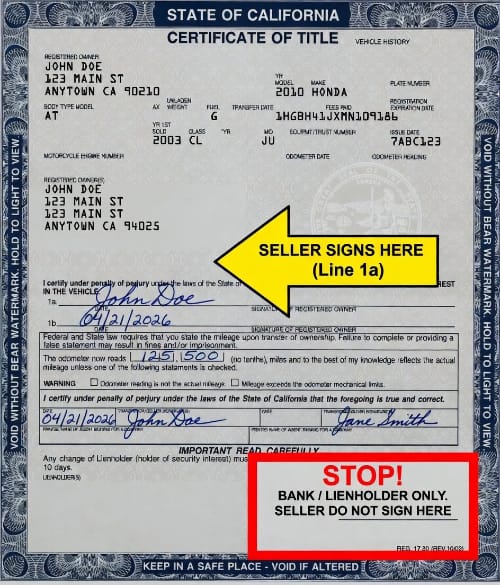
The seller prints a name, signs under penalty of perjury, dates it, and adds a license number and mailing address. Notice what’s missing: the buyer never signs a REG 135. The buyer’s block takes a printed name and address only, which surprises people who expect a contract. The signature burden sits entirely on the side declaring the facts.
Want to see all of it done instead of described? Download my free Bill of Sale Examples Pack: three completed REG 135 forms, a standard sale, a family gift, and a seller who isn’t on the title, filled out from the VIN to the signature.
Writing your own bill of sale, because handwritten is legal
California accepts a handwritten bill of sale, and sometimes the form isn’t within reach when the cash is. To hold up, yours needs the date of sale, both parties’ full names and addresses, the price paid or the gift value with the relationship, the vehicle’s year, make, VIN, and plate, and the seller’s signature. Skip any of those and you’ve written a note, not a document. Since the official form asks for exactly this list with the blanks pre-labeled, the only reason to handwrite one is a sale happening faster than a printer can.
The title trick almost nobody knows
Buried in the DMV’s manual sits the bill of sale’s quiet superpower: it’s acceptable in lieu of the registered owner’s release signature on the title. The DMV prints B/S on the release line and processes the transfer. So when an owner sold a car and never signed off, or a middleman bought and resold without ever titling it, a properly signed bill of sale bridges the gap in the chain. That’s also the paperwork reality behind half the calls I get about selling a car without a title, and it’s why Example 3 in the pack shows both signature rows working.
Where the bill of sale stops and other forms start
A bill of sale records a sale. It does not transfer ownership, the title does that, and my guide on filling out a California title covers every line of it. It also carries no odometer disclosure, so a lost-title transfer on a newer vehicle still needs the security-paper REG 262, which I explained in the form you can’t download. And a vehicle arriving from out of state starts with a different document entirely, the REG 343 application, covered section by section in my guide.
Bill of sale questions from real driveways
Does a California bill of sale need to be notarized?
No, never. The DMV’s manual says it plainly: a bill of sale requires no notary and no witness. Any site telling you otherwise is selling notarization you don’t need.
Is a handwritten bill of sale legal in California?
Yes, as long as it contains the full list above: date, names, addresses, price or gift value, vehicle description with the VIN, and the seller’s signature. The free official form exists so you don’t have to remember the list.
Does the buyer sign the bill of sale?
Not on the REG 135. The seller certifies under penalty of perjury, while the buyer’s section takes a printed name and address only. If a seller insists you sign something extra, read it before you do, because that’s a contract, not a bill of sale.
Is a bill of sale proof that I own the car?
No. Ownership transfers through the title, and the bill of sale supports that transfer. Treat it like the receipt it is, strong evidence, not the deed itself.
Do I need one for a boat, trailer, or motorcycle?
The same REG 135 covers vessels, with the CF number standing in for the plate, and it works for motorcycles and trailers too. One form, the whole driveway.
Do I need a bill of sale when selling to a dealer, or to you?
Dealer sales are exempt, since the dealer’s own paperwork documents everything. Same when I buy: the bill of sale, the release of liability, all of it travels in my folder, and we complete it together on the spot. You sign, I handle the rest.
Four minutes of paper, years of protection
The bill of sale is the cheapest insurance in a private sale: one free page, no notary, honest numbers, and a signature. Print two copies, fill the lines that apply, and keep yours forever.
So if the sale behind the paperwork is the real chore, an older car you’ve been meaning to move or anything with a story attached, skip the driveway negotiation entirely. I bring every form, I fill them with you, and I’m a SoCal resident just like you. I answer personally. I’m not a corporate robot. Cypress office: (714) 900-3723. Van Nuys office: (818) 405-8808. Open 8 AM to 8 PM, 7 days a week. If it’s not the right fit, I’ll lead you in the right direction.